A Decision Has To Be Made
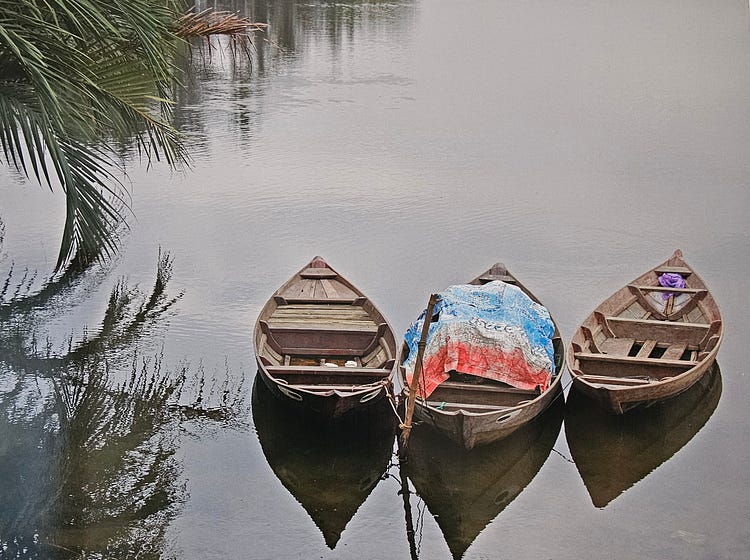
It was small, barely a curve in the coastline, where the water held a stillness that did not belong to weather, I saw three small boats. The sun hesitated to show its face and though a rain threatened, the world stilled. Even the wind seemed to hesitate before crossing the inlet. The palms leaned inward, as if listening. And three boats tied loosely together, floated with the quiet assurance of things that had been waiting a long time.
The bay was one of those places in the world which was porous, a place that stands between the world of humans and an alter reality. Standing at the edge of the bay, without knowing why I was there, I sensed the presence of a thin, invisible doorway.
I did not step through the portal which waited. I hesitated worried that I would look foolish stepping through space only to disappear or to find myself floundering in the silty water. I stood unable to commit to enter the unseen portal, or to turn my back and walk on. I felt the air shift around me, as though the world were adjusting itself to make room for my decision. Something on the other side of that invisible doorway had noticed me and was waiting to see what I would do.
The three boats rocked gently, their hulls touching with the soft familiarity as if they were old companions. They were simple vessels, worn smooth by years of sun and salt. Yet each carried a different presence, a different weight. The one on the left was sturdy, its wood darkened by time. The middle boat was partially covered with a tarp of muted colours, as though guarding something fragile. The third spoke of sparseness.
I stared at the them. I was certain that I had been here before in a dream which I couldn’t fully recall. The portal stood between me and the boats, hovering unseen above the water. As I stood, caught between worlds, a voice drifted toward me, as soft as the first stir of wind.
“You came early.”
I turned to see who had spoken. An old woman stood among the palms, her posture straight, her eyes bright with the kind of clarity that comes from having lived long enough to stop pretending. She wore no expression of surprise at finding me there. If anything, she looked faintly relieved.
“I didn’t know I was expected,” I said.
“People rarely do,” she replied. “But the bay knows. It calls those who have begun to outgrow their own lives.”
She walked to the water’s edge and looked at the boats with the familiarity of someone greeting old friends.
“These three,” she said, “are older than the village that once stood here. Older than the stories people tell about them. They belong to the threshold where the seen and unseen meet.”
I stepped closer, drawn by something I could not name. “What are they waiting for?” I asked.
She smiled, not unkindly. “Not what, but who. They wait someone who is ready to listen.”
The wind shifted then, brushing the surface of the water. The boats rocked in unison, as if acknowledging the conversation.
The woman gestured toward the first boat. “This one holds the weight of what has been carried too long,” she said. “The burdens people mistake for identity. The roles they never chose but learned to perform. The stories they inherited before they had a voice.”
I felt a tightening in my chest, the familiar ache of a life lived according to expectations I had never questioned.
She moved to the second boat, the one with the tarp. “This one holds the weight of what has been protected,” she continued. “The fragile things. The unspoken things. The memories wrapped so tightly that even their owner forgets what lies beneath.”
The tarp fluttered slightly, though no wind touched it.
“And the third?” I asked, my voice quieter now.
“This one holds the weight of what has been lost,” she said. “Not just people, but possibilities. Choices not taken. Words not spoken. The versions of oneself that drifted away.”
The boat stirred, as though remembering a touch.
I looked at the three boats, feeling the subtle pull of each. They were not symbols. They were invitations.
“Why are you show me this?” I asked.
“Because you are standing at the doorway,” she said. “And you cannot cross it carrying everything you brought with you.”
The inlet grew even quieter. The air thickened, not with humidity but with meaning.
“What happens if I choose one?” I asked.
“You do not choose,” she said. “You are chosen. The boat that calls to you will reveal what you are ready to face.”
I closed my eyes. The world behind my eyelids was dark, but not empty. I felt the presence of the three boats like three distinct heartbeats.
The first pulsed with heaviness, with the weight of obligations, of identities worn thin. The second pulsed with secrecy, of the things I had hidden even from myself. The third pulsed with longing, the ache of what I had lost or abandoned.
When I opened my eyes, the old woman was watching me with a patience that felt ancient.
“Go,” she said softly. “Let the water speak.”
I stepped toward the boats. The sand shifted beneath my feet, warm and damp. The inlet’s surface reflected the sky in a way that made it impossible to tell where one ended and the other began.
I reached the first boat. The air around it felt dense, as though filled with the breath of all the selves I had pretended to be. I touched the wood. It was solid, familiar, almost comforting in its heaviness. But the comfort felt like a trap, a room with no windows.
I stepped back.
I approached the second boat. The tarp rustled, whispering secrets I had long avoided. I felt the pull of it, the desire to uncover, to understand, to finally look at what I had hidden away, even from myself. But the pull was sharp, almost painful. I was not ready.
I stepped back again.
Then I approached the third boat.
I saw a small cloth, its colour shifting subtly with the light. When I placed my hand on the edge of the boat, the wood felt warm, not from the sun, but from something alive beneath the surface.
The boat rocked gently, as if greeting me.
A quiet certainty rose in my chest. This was the one. Not because it was easy. Not because it was safe. But because it held the ache I had never allowed myself to feel fully, the ache that had shaped me more than any success or failure.
I stepped into the boat. The inlet exhaled. The old woman nodded once, as though acknowledging a truth I had finally admitted to myself. The boat drifted, not outward but inward, toward the darker part of the inlet where the reflections deepened and the air grew stiller.
I did not know what waited there. But for the first time in my life, the unknown did not feel like a threat. It felt like a beginning.