A moment along the Mekong River in Laos
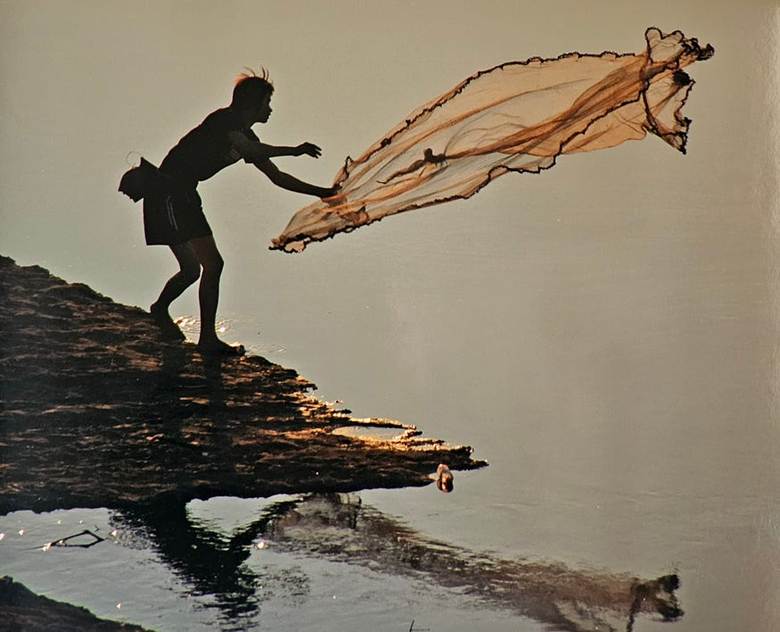
They say the Mekong is a river only in the way a body is a body. Those who live along its banks step toward the water with a quietness that borders on reverence, as though approaching an elder who has seen too much to be impressed by human urgency.
The young man who came each morning did not bow, but he paused. That small hesitation was his offering. His name was Somchai, though the villagers usually shortened it to Chai, a name easier to say. He was nineteen, but the river had already begun its slow work on him seen in the way he listened, the way he moved with a patience that did not belong to youth.
He stood barefoot on the damp bank, in the early light. Smoke from distant cooking fires drifted in thin threads behind him. The river held its usual calm, but beneath that calm he sensed a stirring, the kind that has nothing to do with weather or tide.
He lifted his net and cast it in a wide, practiced arc. The net opened above him like a breath released, then settled onto the water.
Chai waited, not with impatience but with the quiet attention of someone who has learned that the river does not respond to force. His father had taught him that before the fever hollowed him out, leaving Chai with a net, a family to feed, and a grief that settled into him like sediment.
The surface of the water shimmered. He pulled the net.
It rose with weight, but not the familiar, wriggling weight of fish. This was a different heaviness, the kind that belongs to objects that have waited a long time to be found.
When the net broke the surface, he saw only a single stone caught in its mesh.
It was smooth, shaped by years of water, but etched with markings that resembled script. He held it in his hands, and something in him shifted, the way a locked door sometimes shifts when the right key is near.
He knelt at the water’s edge. The river was quiet as though it were listening.
“I don’t know what you want,” he said, his voice barely heard above the sound of the current. “I only know I need to feed my family.”
The water touched the shore in a slow, deliberate rhythm, as though acknowledging the truth of his words.
He looked again at the stone. The markings seemed to pulse, not with light but with intention. He placed the stone on the water.
It floated.
It drifted outward, turning slowly, as though guided by a current he could not feel. For a moment, the river’s surface deepened, revealing shapes beneath it, their movements belonged to another order of being, something fluid and ancient.
He blinked, and the shapes dissolved.
The stone stopped a few feet from shore.
A voice rose then. It was neither male nor female, neither young nor old. It carried the timbre of something that had never needed to raise its voice.
“You cast your net for fish, but the river casts its net for you.“
Chai felt his breath catch.
“You carry more than hunger,” the voice continued. “You carry the weight of those who depend on you, the ache of what you have lost, the fear of what you cannot shape.“
The words named what was already true.
“But you also carry patience,” the voice said. “And a listening heart. These are the qualities the river recognizes.“
The stone drifted back toward him, as though returning something he had not realized he had offered.
“You are not alone,” the voice said. “The river remembers your father. It remembers your grandmother. It remembers every hand that has ever cast a net in hope or in despair. It remembers you.“
He lifted the stone from the water. It felt warm now, as though it had absorbed something from the river.
“What am I meant to do?” he whispered.
“Fish,” the voice said. “But not only with your hands. Fish with your memory. Fish with your grief. Fish with the understanding that you are part of something larger than your hunger.“
The shimmer faded. The river returned to its ordinary calm, though Chai sensed that nothing was quite the same.
He cast his net again.
This time, when he pulled, the weight was familiar with the solid, wriggling weight of fish. More than he had caught in weeks. Enough to feed his family for days.
He did not smile with triumph. He simply breathed, deeply, as though the river had lent him a breath of its own.
He gathered his net, tucked the stone into his bag, and began the walk home. The morning light warmed his shoulders. The fish weighed down his hands.
He did not look back at the river. He didn’t need to. He could feel it watching him.
Leave a Reply