Les Longpré
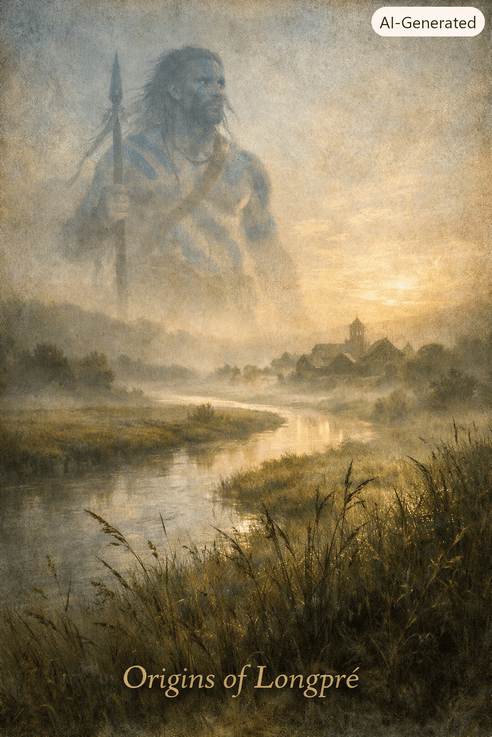
I am finally getting serious about a historical fiction that looks at how my family came to be in this modern world. The earliest known Longpré was mentioned in an obscure work where a Guillaume Longpré was supposedly in a minor supporting role at the Battle of Hastings in 1066. Of course, the family didn’t begin then. He had parents, grandparents and the roots go far, far back in time. For this story, I am starting in the middle of the seventh century.
I had my DNA analysed and found out that the roots, my roots, are tied to Northern France, Scotland, and the Norse peoples that we know as Vikings. There are others in the DNA mix, but they are not as prominent. It was this knowledge that had me begin in Scotland. I am writing the story in Parts. The prologue sets the scene in what is today called Aberdeenshire, the homeland of the Picts, a mysterious people with Celtic associations. The Picts didn’t disappear, they became absorbed over the years.
The Longpré name comes from what we know as Longpré-les-Corps-Saints. Before 1205 AD, the place had the name Longpré. And before that it was called Longum Pratum in 1066 AD. All of that is in written historical documents. The neighbouring town of Long was called Longus Superior in 855 AD, then Longo, and then Longum. That is what history tells us about these two villages which are less than five kilometres apart. Both places existed long before written records mention them. It is most likely that the village of Long was the first town and that its own people build habitations in the meadows which gave rise to “long-meadows” or Longpré.
The Romans mentioned villages in the area and there is archaeological evidence of villages dating from the time of Caesar being there in 57 BC. The people living in the area were Celtic and called Ambiani. And so it goes on and on backwards in time. There is no way I am going to track all of this as it would be an impossible task. What leads me to begin in Scotland in the middle of the 600s is what I can best call a woad culture, a warrior culture which is matched by a woad culture in Denmark and in France along the river where the villages of Long and Longpré are found.
The story which will emerge here is one that tells the plausible story of a land that eventually gave rise to the Longpré family. Though the story will have real historical figures, the novel isn’t about them. In the end, it is the story of a family that passes through me to my grandsons, a thread that adapts to the passing centuries, blending other families in the process.
Should I have started the story in the late 1600s when the family arrived in North America from Rouen, France? I thought long and hard about this. My friend, Yann Longpré has written an encyclopaedic two-volume series which is replete with family trees dating back to the Guillaume Longpré’s arrival. That isn’t a story and I want to write a story.
6 thoughts on “Les Longpré”
Very informative…
Thank you, Arjun. The story begins to be told on Friday and will appear on a somewhat regular basis over the summer.
I would love to read the story…
My grandparents also left the village in 1947 during partition….came to India from the village which is now in Pakistan…..
Read away, my friend. The story goes back into the distant past, a place in time where managed to find traces of my roots from 1000 years ago.
Excellent! Will be fascinating!
I’m glad that you’ll be following the story. Just and fyi, your dad and I are likely 5th or 4th cousins as we share an ancestor.