Les Longpré – Chapter 2
Kettil led a contingent of six longboats past a place called Abbéville. The river further upstream continued to be slow moving allowing the longboats easier passage down the River Samara. Kettil knew that this river, despite its calm waters had a turbulent history, a place where cultures clashed and many died in ferocious combat. The old tales told of the Ambiani as warriors just as fierce as the Picti across the sea he had just traversed.
The river valley was rich and coveted because of its wealth. The tranquil water fed bogs that provided peat, just like the lands of his wife in Danmǫrk and even the lands of the Picti. His homeland was not as blessed. His Kingdom of the Western Isles was extremely rich in peat bog, but couldn’t compare with the forests, bogs, and temperate climate of the river valley.
“Thórólfr, this is the land I have long dreamed of,” Kettil said with his eyes refusing to leave the land that edged the river. “This land is so peaceful. Look,” he spoke as he pointed out a few thatched homes on one of the promontories of land bordering a nearby bog, “their homes are evidence that this is a peaceful land.”
“I agree, Kettil. I haven’t seen any fortified villages or churches since we left Abbéville. But if you think about it, that likely means there will be slim pickings here.”
Thórólfr was a warrior and was only happy when he was heading out for viking. Pillaging, claiming the women and children of vanquished communities, as well as the wealth of a headman and the local church, that was Thórólfr ‘s definition of a good life.
Further along the edges of the river, small plots of land were covered with yellow-flowered cabbage-like plants, a plant called Woad. Woad yielded an Indigo blue dye, when processed. It was this dye which had been made famous by the Celts.
“There, see those plants, Thórólfr? That’s the source of the blue dye used by the Picti.”
“The bloody Picti are devils, naked devils in battle. It was the best thing you have done to make those people your allies in the Western Isles. Better to have them as allies than as enemies. They’re savages, naked savages. They’ll never be tamed or civilised.”
Kettil raised his eyebrows in response to Thórólfr’s words.
“No, not savages, Thórólfr. Different, yes. But savages? They’re just fierce protectors of their land and people.”
Thórólfr kept his mouth closed in response. Kettil was a great leader, a famed warrior, but he also had a soft spot that was growing with the passing years. Unlike, Kettil, Thórólfr had no desire to settle down. His only ambition was to one day die in battle, an honourable death that would immediately allow him to go to Valhalla.
“Don’t let the peaceful scenes here fool you, Thórólfr. Something tells me these people along the river are just as fierce as the Picti. The old Ambiani peoples are still here, hiding in plain sight as farmers and hunters.”
Hrólfr, knew that as the second son, he could not become the next king of the Western Isles. That crown was destined to go to Gurim. What Hrólfr didn’t know was that Kettil was looking for new lands, with the hopes of giving Hrólfr a kingdom of his own. Kettil saw much about this river valley land that could make for just such a kingdom.
At the northern edges of the river, with extensive bogs to the south, Kettil finally saw what he was looking for, a more prosperous looking village. There was a small wooden church which suggested that there would be little in it for treasure. Many of the houses in the village were wooden like the houses in Abbéville. But along the edges of the forest and the bogs, thatched rooves indicated a different culture. Kettil surmised that they were the homes of the Ambiani, at least the Ambiani who were slower to adopt Frankish culture.
“There!” said Kettil pointing out the village to Thórólfr and Hrólfr, “Are you ready to see a bit more action? Just one thing. Only the church and the plank-roofed building are to be pillaged. Keep the killing to a minimum. I want as many of the villagers left alive as can be accomplished while still ensuring victory. Once the village has been taken, I will make decisions which will be honoured. In addition, leave the thatched rooved houses untouched. I don’t want to make enemies with the Ambiani, who are the likely residents of those homes. Importantly, don’t kill the priest. I don’t want to have an army of Christians to confront when we head back downstream to the sea.”
* * *
The raid didn’t meet with a lot of resistance. For some strange reason, many of the houses were empty. When Kettil’s men had secured victory, he had some of the Franks executed. He had the priest spared. He was surprised that it had been so easy.
As the men celebrated with pillaging the buildings with planked rooves, Thórólfr wordlessly drew Kettil’s attention to the shadows at the edge of the forest. There were men and women, armed and looking formidable. They outnumbered Kettil’s men and could have caused a bloodbath, killing many of his men.
“They are the Ambiani,” Kettil said as he turned to face the shadows. He put his axe down and slowly approached and then stopped when he had covered half of the distance.
A grey-haired woman stepped forward and spoke for those behind her. “You have spared my people’s homes. However, you have also put my people at risk. The soldiers of the Church and the count of Amiens will exact compensation from us once you leave. They will assume that we did nothing to protect the Franks.”
“What do you suggest?” Kettil asked with a tone of respect for this grey-haired woman who bore the tattoos of a tribal leader.
“Leave some of your men here to replace the Franks they have killed. Mercy on your part will make it easier to keep our village safe from the Church and the Count of Amiens. Let one of your people become the headman of the village. Otherwise, a village with only Ambiani left in the village would raise too many suspicions. It is also a good thing you have not killed the old priest.”
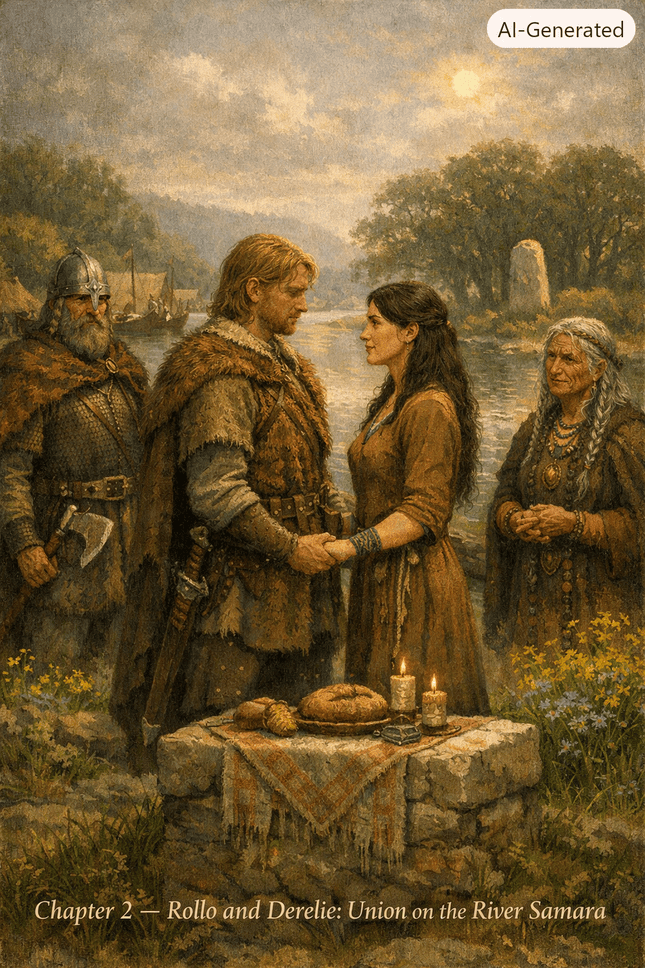
“Wise counsel,” Kettil admitted. “I will do as you say. I ask one other thing. Let us unite your people and mine through a marriage. My son Hrólfr is not yet betrothed. Choose a young woman from your people to be his wife. This will have us, Danes and Ambiani united as family.”
Hrólfr was surprised that he had been offered as a prize to the Ambiani. He was even more surprised at learning he would be called Rollo. He was curious about who would be his bride. Would she even be pleasant to look at? Like other young men his age, he was well aware of what marriage meant. He had never expected it to happen for at least two more years, though he knew it would be to a woman picked by his father.
The old woman smiled as she turned and nodded to several others in her group who had gathered. She had been told about this union of Dane and Ambiani years earlier as a prophecy from the keepers of the old religion. These keepers of the old way were men and women who still met within a secret grove surrounded by oak trees less than a day’s travel from the village. There, a simple stone stood, a reminder of the old religion. It was there that prophecies about the future were revealed.
After a short discussion between the assembled Ambiani, the old woman again spoke, “It shall be as you say, Kettil, the Flatnose. There is just one more thing needed. He must have a name which will raise less suspicion. He will be called Rollo, a name that is not Norse and can pass as Frankish.”
A few moments later, a young woman named Derelie was presented as the intended bride. She was the same age as Hrólfr. He looked at the short, dark-haired young woman and felt a stirring of desire within him. He was not a virgin. Like most Danish and Norse youth, both male and female, he was no stranger to sexual intercourse. Among his own people, intercourse was only by mutual consent. Rape was punishable by death, an ignoble death wherein Valhalla would be denied.
However, the rape of foreigners was seen as plunder. Not known to either Kettil or Hrólfr was that Derelie was the granddaughter of the old woman who was named Tatha, in honour of the River Goddess whose name was given to the ancient village before the Romans arrived.
Hrólfr married Derelie according to the Danish customs, as well as by the customs of the Ambiani. The marriage was consummated frequently over the next two weeks. Kettil left one of the longboats and its crew at the village of Long, before he and Rollo sailed off to return to the Kingdom of the Western Isles in Scotland. The men who remain behind took wives among the widowed French women who were given the option of being slaves or wives. There were also a few willing Ambiani women who chose Norse husbands.
The men left behind were older, seasoned men who were familiar with the French language, men who would pretend to be Christians and Franks. The priest willingly baptised the heathen Danes and married them according to the Church’s rites. He counted himself lucky that he hadn’t been martyred. To the outside world, it would appear as though nothing had changed in the village of Long.
Though baptised, the men were still Norsemen, sworn warriors to Kettil, They were Norse and did not forgo their own religious beliefs. Baptism as Christians was a political act and had nothing to do with their private beliefs.
And so, it came to be in 868 that Hrólfr became Rollo, the husband of Derelie, He was the nominal headman of the village of Long and would be called Rollo du Long when he returned to the River Samara.
He was still too young to become the acting headman of the village, and he had too much yet to learn to remain in the village. Kettil appointed one of his men to rule in Rollo’s name, a man who had married the French woman who had been the wife of the village headman before he was executed by Kettil.